
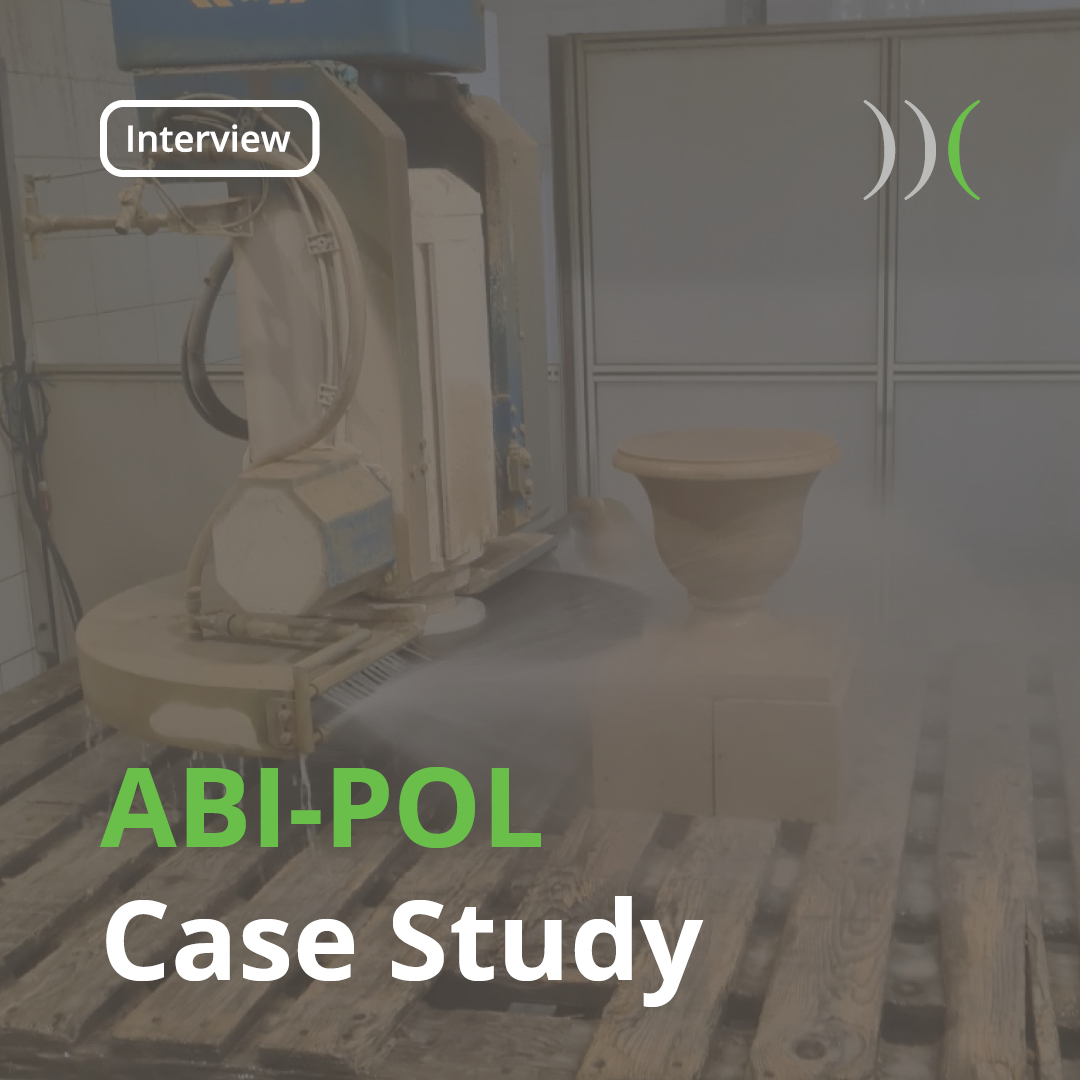
In Proszówka, Poland, ABI-POL specializes in machining natural sandstone, both for new builds and for the restoration of architectural elements.
Our Area Manager Karol Parcia sat down with Tomasz Zjawin, Production Manager, to find out how the team approaches production when all they have to go on is a customer’s photo or sketch.
Knowing the material and its properties is essential, but it isn’t enough: turning a drawing into a finished piece also takes precise communication between software and machine. That’s why CNC sandstone machining is at the heart of Tomasz’s story, using the Donatoni QUADRIX 5-axis bridge saw and EasySTONE®, our CAD/CAM software for stone.
Want to learn more about ABI-POL’s workflow? Keep reading.
What Does ABI-POL Do?
Since 2003, ABI-POL has been producing sandstone products for the Polish market and for customers abroad.
In addition to façade cladding, the company makes stairs, windowsills, and surrounds. The core of its production, however, is custom projects: garden features, fountains, sculptures, decorative pieces, and architectural ornaments. ABI-POL also restores architectural stone elements.
During the interview, Tomasz explained that customers often don’t come with a ready-made technical solution. They show up with a design, a photo, or an existing piece and ask for a new version of it.
And that, he says, is where the most interesting part of the job begins. “A photo shows the end result, but it doesn’t tell us how the piece was actually made.” Before anyone touches the block of stone, the team has to think through geometry, structure, fixing, and machining. That’s how an idea takes the shape the customer had in mind, and technical know-how becomes concrete production steps.
Want to know how EasySTONE® can fit into your production workflow?
CNC Sandstone Machining: How It Differs from Other Natural Stones
Sandstone is a sedimentary natural stone. It forms from grains of sand, mostly quartz, compacted over millions of years. The grains are held together by a natural cement that can be siliceous, calcareous, clayey, or rich in iron oxides.
Cement is what determines how a block behaves: sandstone with a siliceous cement is dense and durable, while clayey or calcareous sandstone is softer and more porous. Iron oxides give the stone its colors, which range from yellow to red.
As the sediments settle, they form laminations: thin, distinct layers that give the rock its characteristic layered structure. If you machine it, that means working with a material that is less cohesive along its bedding planes and more prone to splitting. Its porosity also makes it sensitive to water, while the quartz in the grains is abrasive and wears down tools.
Tomasz describes sandstone as a material that gives you a lot of room to work with when machining. Still, you have to account for its grain, bedding, and any weak spots. It’s also not as strong as marble or granite, which customers tend to underestimate. That’s why the geometry drawn in the software isn’t enough on its own: you need to know whether it works on that specific block. If the block has a weaker area, you sometimes have to change the machining strategy or even the design itself.
Why a Donatoni QUADRIX and Not a JET 625?
ABI-POL’s machine fleet includes a Donatoni QUADRIX. The company chose it over the JET 625, the more popular model, for one specific reason: Z-axis height. ABI-POL often produces very large pieces, and Z-axis travel determines how tall a block you can machine.
The result, Tomasz says, is the ability to combine the high precision needed for complex pieces with the freedom that custom projects and restoration work demand.
The Role of CAD/CAM Software: From Design to Finished Product
In restoration work, customers often come in with a photo, a fragment of the piece, or a hand-drawn sketch on graph paper.
The first step is figuring out exactly what needs to be reproduced. When the new pieces have to match existing elements exactly, the team asks the customer to trace the profile onto cardboard and send it in as a template. That way, the new pieces match the originals.
Starting from a simple photo, Tomasz prepares a technical design that has to be approved by the customer and often by the historic preservation office as well.
How to Make the Most Out of EasySTONE®
Once approved, the design is broken down and the geometry is translated into machining operations. The more complex the piece, the more carefully the program has to be set up.
This is where EasySTONE®, our stone machining software, comes in. The most useful CAD/CAM features in a workflow like ABI-POL’s include:
- importing geometry and models in DXF, IGES, STL, PNT, and Rhino (3DM) formats, including STL files from 3D scans
- automatic toolpath calculation from the 3D model, with customizable parameters
- 3D machining simulation with collision checking and toolpath optimization
- managing multiple 3-, 4-, and 5-axis machining centers, including interpolated machining, from a single software package
For Tomasz, the machine and the software are two parts of the same process: the machine physically cuts the block, and the software is what lets you actually use the machine. With EasySTONE®, ABI-POL goes from a model to a machine-ready program, and from one project to the next, without rebuilding the process from scratch every time.
Evaluating CAD/CAM software for your shop? We’ve rounded up the key criteria for choosing a CAM system for stone machining in one article.
The Future of the Stone Industry According to ABI-POL
For ABI-POL, investing in technology isn’t just about boosting productivity. The priority is expanding what the company can do. When a new technology makes it possible to produce something that used to be too labor-intensive, new opportunities open up and the company’s offering grows.
And what will sculptors’ role be 10 or 20 years from now? “A machine can reproduce a design with great precision, but it can’t replace experience, a feel for the material, or what a skilled hand can do in the final finishing,” says Tomasz, ABI-POL’s Production Manager.
Today, ABI-POL describes itself as the place where natural stone, people’s experience, and technological progress come together. That’s why, when a customer shows up with a truly out-of-the-ordinary design, Tomasz first evaluates every element and only then works out how to make it.
Do you machine stone on a 5-axis CNC machining center and want to see how EasySTONE® can handle your custom pieces?